I've been in conversation with many professional speakers in both the UK and the US over the past two weeks. One topic of conversation has been the increasing number of requests we receive to speak in return for a donation to charity.
The speaking profession, and the members thereof, are the most generous and giving people I've ever come across. Each of us has our own charities and causes that we support, in our own private ways. In addition, many of us offer greatly reduced fees for charity events. Now and again, we speak for free.
For many years, I, along with many other speakers, have received requests to speak for free, from organisations who have limited funds. I don't mind them asking, and I have a policy of accepting a maximum of one such request each month. Many other speakers have similar policies.
Of late, the requests often come in this form. "We'd like you to speak at our event. We recognise that you are a professional, so we are offering a reasonable fee. Would you be free on this date?" Sometimes the fee is specified, sometimes not. If the date is free, I make a provisional booking and pass the details on to my business manager. A couple of days later comes another call. "Alan, all of the other speakers have agreed to donate their fees to charity (always a good cause, such as a hospice, or cancer charity).Would you agree to do that same?". Now I have a problem. I've confirmed that I'm free on the date. I've expressed interest, maybe even agreed a fee. I now have to either appear uncharitable, by insisting on receiving a fee, or decline to speak, citing some excuse. It's an insidious form of blackmail, in my opinion. On one occasion when I did appear under these conditions, I asked to see evidence of the charity donation. The organisers told me it wasn't possible, and that I should show more trust in them.
I know many professional speakers who have received similar approaches. There's often a rider attached, such as "Of course, we'll be promoting you to our database, and you may meet people who want to purchase your services". The unstated irony is that I am delivering my services effectively for nothing at the event itself. Since I receive most of my income from speaking fees, I am effectively under-valuing my professional expertise by appearing.
I've never met a caterer, a venue hire manager, or a security team, who were asked to donate their event fees to charity. My advice to professional speakers is to be careful of "fee to charity" events. They may be genuine, and you may decide to take them. If you do, be sure that there really is a fee to charity. If you decide to decline the request don't feel guilty about it.

Thursday, July 29, 2010


Saturday, July 24, 2010
The web for knowing, A handshake for closing
There are many, many individuals who, in my opinion, are wasting time, money and effort trying to sell their services online. They include coaches, trainers, consultants and other providers of "soft" services which include a major element of person-to-person contact.
We all know the mantra of find, know, like and trust that is part of the sales cycle. It's true, and has been for thousands of years, that we buy from people we trust. But trust, as we also know, is hard to establish online. It stems most strongly, and most easily, from personal recommendation from another person we trust. In the absence of direct recommendation, trust can be enhanced by testimonials, case studies, and reputation.
So here's my take. I'm happy to buy a commodity online - a music download, a flight, a hotel. I'm more wary of buying a more "risky" product, such as a financial service, but I'm prepared to go with a well-known brand, probably one that I know in the physical world (First Direct being a prime exception to that rule). However, would I buy a service such as business coaching or marketing services from a company I had only encountered on the web? Absolutely not.
I had this discussion with a group of fellow speakers at a convention in Orlando earlier this week. All agreed that they would only buy high-cost person-to-person services from someone who was not only recommended by a friend, but that they had met face-to-face.
So here's my advice. We all need websites and a social media presence. But for many of us, that's not enough. We need to get out there and meet people in the real world. We need to speak and offer help and advice in person. It may sound old-fashioned, but that's still how high-value relationships are created. Fair enough, the initial contact may be online, but the deal will normally be closed in person.
In the past 20 years, I've met a lot of people who are trying to sell person-to-person services solely via websites, SEO, email marketing campaigns and the like. A few are successful, but a lot aren't. The most successful people I know have built a network of strong, real-world relationships with people who trust them and recommend them constantly.
Golfers say "I drive for flash an putt for cash". I say "The web for knowing, A handshake for closing"
We all know the mantra of find, know, like and trust that is part of the sales cycle. It's true, and has been for thousands of years, that we buy from people we trust. But trust, as we also know, is hard to establish online. It stems most strongly, and most easily, from personal recommendation from another person we trust. In the absence of direct recommendation, trust can be enhanced by testimonials, case studies, and reputation.
So here's my take. I'm happy to buy a commodity online - a music download, a flight, a hotel. I'm more wary of buying a more "risky" product, such as a financial service, but I'm prepared to go with a well-known brand, probably one that I know in the physical world (First Direct being a prime exception to that rule). However, would I buy a service such as business coaching or marketing services from a company I had only encountered on the web? Absolutely not.
I had this discussion with a group of fellow speakers at a convention in Orlando earlier this week. All agreed that they would only buy high-cost person-to-person services from someone who was not only recommended by a friend, but that they had met face-to-face.
So here's my advice. We all need websites and a social media presence. But for many of us, that's not enough. We need to get out there and meet people in the real world. We need to speak and offer help and advice in person. It may sound old-fashioned, but that's still how high-value relationships are created. Fair enough, the initial contact may be online, but the deal will normally be closed in person.
In the past 20 years, I've met a lot of people who are trying to sell person-to-person services solely via websites, SEO, email marketing campaigns and the like. A few are successful, but a lot aren't. The most successful people I know have built a network of strong, real-world relationships with people who trust them and recommend them constantly.
Golfers say "I drive for flash an putt for cash". I say "The web for knowing, A handshake for closing"
Friday, July 23, 2010
Message first, social media second
Some people are so beguiled by a new piece of social media technology that they overlook the message they are using it to deliver. Of course, finding more efficient ways to deliver our points is always a sensible quest, but we must never forget that social media, and social networks, are tools, not an end in themselves.
Permit me to take this a stage further. If you have a powerful, timely message, it will be heard regardless of the methods you employ initially. You may decide to run a YouTube campaign to promote your latest book. People may start talking about it on Facebook, which attracts the attention of broadcast media, such as TV and radio. Before you know it, you have a wider audience using channels you hadn't planned to use that in the media that you had carefully planned for.
That's why, in my opinion, all campaigns should start with the core message, and then seek the best way of delivering it. You should also be prepared to switch your media focus at short notice. It's not about the medium, it's about the message. Maybe that's not the way Marshall McLuhan would have seen it, but it's my take.
Permit me to take this a stage further. If you have a powerful, timely message, it will be heard regardless of the methods you employ initially. You may decide to run a YouTube campaign to promote your latest book. People may start talking about it on Facebook, which attracts the attention of broadcast media, such as TV and radio. Before you know it, you have a wider audience using channels you hadn't planned to use that in the media that you had carefully planned for.
That's why, in my opinion, all campaigns should start with the core message, and then seek the best way of delivering it. You should also be prepared to switch your media focus at short notice. It's not about the medium, it's about the message. Maybe that's not the way Marshall McLuhan would have seen it, but it's my take.
Tuesday, July 13, 2010
Social media; time to get serious
The hype around social media is beginning to die down. Now it's time to get serious. If you are going to make use of social media in your business (and you don't have to), then you need to have a strategy, a plan to measure the results, regular checkpoints, and a willingness to put some resource behind your efforts. Here are a few tips to crank up the volume on your social media campaigns.
* Make sure you can measure your results. If you can't measure, you can't judge how well you are doing. There are plenty of tools available.
* Behave professionally. Don't leave your Twitter feed to the office junior (unless they are very good).
* Get your internal people trained, so they are confident to use social media responsibly.
* Look for niches and special areas where your customers are speaking. You don't need a presence on every social network.
* Don't hide your involvement. It's no longer the time for limited test sites. Go mainstream.
Finally, don't believe what external advisors and consultants tell you without reviewing their evidence. By now, anyone who advises on social media policy should have a track record of success. If you're serious about social media, you need solid professional advice.
* Make sure you can measure your results. If you can't measure, you can't judge how well you are doing. There are plenty of tools available.
* Behave professionally. Don't leave your Twitter feed to the office junior (unless they are very good).
* Get your internal people trained, so they are confident to use social media responsibly.
* Look for niches and special areas where your customers are speaking. You don't need a presence on every social network.
* Don't hide your involvement. It's no longer the time for limited test sites. Go mainstream.
Finally, don't believe what external advisors and consultants tell you without reviewing their evidence. By now, anyone who advises on social media policy should have a track record of success. If you're serious about social media, you need solid professional advice.
Wednesday, July 07, 2010
Who cares what you say on social media?
Many people accuse users of social media of posting uninteresting trivia about their lives. In some cases, that's a fair criticism. If all you ever hear is the regular daily goings-on of an uneventful existence, it's hard to maintain your interest. On the other hand, a constant stream of "inspirational " quotes is not going to win you many followers, or even keep the ones you have. The answer is not full-on marketing either, since that will turn people away even more quickly than trivia. Worst of all, in my opinion, is the automatic broadcasting of news-related links in a never-ending stream of headlines. It's obvious that it comes from a machine, not from you.
So what is the answer? In my opinion, it's to communicate something useful - a piece of advice, a recommended restaurant, a place to buy great-value products. Think about the conversations you have with your friends. Sometimes you chat about music or sport, sometimes you offer advice, sometimes you may ask for help. That's why people like you. But if your conversation is dull, they will turn away, or look at their watch as they remember an urgent appointment.
Social media is about conversations. It's not about being dull, nor is it one-way. If you join the conversation, you will find that people do care what you say. You may do business with them you may not, but you'll be doing something interesting and useful. People will recommend you too, and business will come your way when you aren't even asking for it.
So what is the answer? In my opinion, it's to communicate something useful - a piece of advice, a recommended restaurant, a place to buy great-value products. Think about the conversations you have with your friends. Sometimes you chat about music or sport, sometimes you offer advice, sometimes you may ask for help. That's why people like you. But if your conversation is dull, they will turn away, or look at their watch as they remember an urgent appointment.
Social media is about conversations. It's not about being dull, nor is it one-way. If you join the conversation, you will find that people do care what you say. You may do business with them you may not, but you'll be doing something interesting and useful. People will recommend you too, and business will come your way when you aren't even asking for it.
Friday, June 25, 2010
Will England win? Let me cast the Rooneys.
Will England win?
Let me cast the Rooneys.
Take Hart, we're not Green. Every England player is a King. We will not Crouch, we will defeat Defoe, and cause an Upson. Don't Warnock the team, we're well Gerrard, us. Like Coles to Newcastle, we're gonna Lampard the Germans. Like Lennon, we imagine the best. We will not Terry, but our Milner-pound players will deliver a Wright-Phillips. They will Carragher us to victory.
Let me cast the Rooneys.
Take Hart, we're not Green. Every England player is a King. We will not Crouch, we will defeat Defoe, and cause an Upson. Don't Warnock the team, we're well Gerrard, us. Like Coles to Newcastle, we're gonna Lampard the Germans. Like Lennon, we imagine the best. We will not Terry, but our Milner-pound players will deliver a Wright-Phillips. They will Carragher us to victory.
Tuesday, June 15, 2010
How to have stage presence
Having a good script is one thing. Having presence on stage is another. Some people seem to have natural confidence on stage, others want to hide behind the lectern. Here are a few tips to enhance your presence on the platform:
* Ask for a wireless microphone, so you can move around
* Visit the stage before anyone arrives, to rehearse and become comfortable
* Plan the areas you can move in so as not to throw a shadow on the screen. Mark your boundaries with small pieces of tape
* Learn sections of your speech, especially the open and close
* Look at the audience, not your notes, when speaking
* Use bold gestures from the shoulder
* Don't move all the time. Stand still to speak
* Stay near the front of the stage
* Show your passion
Above all, keep at it. There's an old adage among speakers; "The only way to get good on the platform is to get good on the platform"
* Ask for a wireless microphone, so you can move around
* Visit the stage before anyone arrives, to rehearse and become comfortable
* Plan the areas you can move in so as not to throw a shadow on the screen. Mark your boundaries with small pieces of tape
* Learn sections of your speech, especially the open and close
* Look at the audience, not your notes, when speaking
* Use bold gestures from the shoulder
* Don't move all the time. Stand still to speak
* Stay near the front of the stage
* Show your passion
Above all, keep at it. There's an old adage among speakers; "The only way to get good on the platform is to get good on the platform"
Monday, June 14, 2010
Prepare to win, like the Germans
There's a small football tournament going on in South Africa right now. I'm writing this the day after the German team thrashed 10-man Australia 4-0 in probably the best performance from any team so far. In many other games, shots, particularly from free kicks, have been flying high and wide, with players struggling to control the "Jabulani" ball. How did the Germans manage to hit the target so often? Maybe it's because their team, all of whom play in the German Bundesliga, have been using the Jabulani ball for months in matches. Co-incidence? Perhaps.
Now consider a completely different competition - the Eurovision Song Contest. Remember who won? That quirky Lily Allen soundalike, Lena from Germany,with "Satellite". The song entered the competition as a certified platinum single, having been at number one in the German charts for five weeks and charting in the top ten in other European countries. Lena won by a huge margin of 76 points.
What's the connection? Preparation. If you prepare to win, you stand a better chance of winning. Whether or not the German team win the World Cup, they can't say they weren't prepared properly. I bet they've practised penalties too.
Think about how you can prepare to win, and give yourself a better chance in business.
Now consider a completely different competition - the Eurovision Song Contest. Remember who won? That quirky Lily Allen soundalike, Lena from Germany,with "Satellite". The song entered the competition as a certified platinum single, having been at number one in the German charts for five weeks and charting in the top ten in other European countries. Lena won by a huge margin of 76 points.
What's the connection? Preparation. If you prepare to win, you stand a better chance of winning. Whether or not the German team win the World Cup, they can't say they weren't prepared properly. I bet they've practised penalties too.
Think about how you can prepare to win, and give yourself a better chance in business.
Friday, June 11, 2010
Social Media is just a con trick
Social media is a con trick. In fact it's at least three cons; Conversation, Content and Consistency.
Conversation - You need to get involved. It's no use simply posting messages saying how wonderful your company is, or what an interesting blog you have just written. You need to respond to questions, add to debates, and offer a point of view on issues. That's what engages people. Don't be scared of getting into a debate and then leaving it again, since it may run for days or weeks. Simply add to the debate while you are there.
Content - You need to offer something useful and of interest. This may seem contrary to what I said above (I'm even debating with myself here), but if you post an interesting and valuable article, other people will publicise it for you. Your comments on other people's blogs may also offer useful content, so don't simply say "I agree" or "This is rubbish".
Consistency - you need to make regular appearances. That does not mean every day, and certainly not every hour. However, if you only appear once or twice a month, post a ton of material and then disappear again, you won't attract many friends. Small, regular postings seem to be much more effective than rare long ones. Little and often - that's the way.
Of course, there is also Connecting, Confidence, Consideration, Congratulating, etc.
Conversation - You need to get involved. It's no use simply posting messages saying how wonderful your company is, or what an interesting blog you have just written. You need to respond to questions, add to debates, and offer a point of view on issues. That's what engages people. Don't be scared of getting into a debate and then leaving it again, since it may run for days or weeks. Simply add to the debate while you are there.
Content - You need to offer something useful and of interest. This may seem contrary to what I said above (I'm even debating with myself here), but if you post an interesting and valuable article, other people will publicise it for you. Your comments on other people's blogs may also offer useful content, so don't simply say "I agree" or "This is rubbish".
Consistency - you need to make regular appearances. That does not mean every day, and certainly not every hour. However, if you only appear once or twice a month, post a ton of material and then disappear again, you won't attract many friends. Small, regular postings seem to be much more effective than rare long ones. Little and often - that's the way.
Of course, there is also Connecting, Confidence, Consideration, Congratulating, etc.
Tuesday, May 18, 2010
Calm down Dear, it's only social media
I've been at a number of event in the past year when that Socialnomics video was shown. Almost without exception, people were astonished and impressed by the statistics, with many worrying that they are already way behind all their competitors in social media usage. The combination of a pulsing Fatboy Slim beat, dazzling graphics and amazing numbers is a heady cocktail.
But hang on a minute. The old maxim about statistics (you know the one I mean) still has some validity. Many of the numbers in the video are somewhat misleading. For example, use of email is included as "use of social media". US statistics for certain age groups are presented without saying so, inferring they apply globally to all ages.
It would be perfectly possible to supply ststistics that show quite a different picture. Such as:
- 74% of the world's population have never used the Internet (Source: Internetworldstats.com)
- Twitter has reached 75 million users, but growth is now less than 8% a month (source (computerworld.com)
- Only 20% of Twitter users are "active" - defined as sending more than 5 tweets ever (source: Computerworld.com)
- If all active Twitter users in the entire world formed a city, it would be smaller than New York (source:Worldatlas.com)
- Only 10.6% of online time is spent on social media sites (source:Experian hitwise)
See what I mean? Depending on the statistics you choose, the perception can be very different.
OK, I can hear you thinking "Come on Alan, you're just an old hack who doesn't get social media". Actually, that's far from the truth. I've written a book about it, I use social media heavily, and I regularly give talks and seminars on the topic. I'm delivering a keynote speech at tthe Social Media in Business conference in London this Friday, for example.
My point is that social media is very important, and hugely significant. However, it can be over-hyped. I see that as a danger. If predictions fail to materialise, people lose interest and become cynical. I'm merely seeking a realistic approach.
When you're in a wood, everything is a tree. We can get so caught up in the world of social media that we think everyone else is, or soon will be. That may not be so, despite neat videos. A sense of proportion may be a handy thing to hang on to.
But hang on a minute. The old maxim about statistics (you know the one I mean) still has some validity. Many of the numbers in the video are somewhat misleading. For example, use of email is included as "use of social media". US statistics for certain age groups are presented without saying so, inferring they apply globally to all ages.
It would be perfectly possible to supply ststistics that show quite a different picture. Such as:
- 74% of the world's population have never used the Internet (Source: Internetworldstats.com)
- Twitter has reached 75 million users, but growth is now less than 8% a month (source (computerworld.com)
- Only 20% of Twitter users are "active" - defined as sending more than 5 tweets ever (source: Computerworld.com)
- If all active Twitter users in the entire world formed a city, it would be smaller than New York (source:Worldatlas.com)
- Only 10.6% of online time is spent on social media sites (source:Experian hitwise)
See what I mean? Depending on the statistics you choose, the perception can be very different.
OK, I can hear you thinking "Come on Alan, you're just an old hack who doesn't get social media". Actually, that's far from the truth. I've written a book about it, I use social media heavily, and I regularly give talks and seminars on the topic. I'm delivering a keynote speech at tthe Social Media in Business conference in London this Friday, for example.
My point is that social media is very important, and hugely significant. However, it can be over-hyped. I see that as a danger. If predictions fail to materialise, people lose interest and become cynical. I'm merely seeking a realistic approach.
When you're in a wood, everything is a tree. We can get so caught up in the world of social media that we think everyone else is, or soon will be. That may not be so, despite neat videos. A sense of proportion may be a handy thing to hang on to.
Saturday, May 08, 2010
From X Factor to Deal or No Deal?: The General Election and TV
There's been a lot of chat about the impact of television on the outcome of the UK general election. In the event, the four-week campaign seems to have had little impact on each party's share of the vote.
The initial leadership debate appeared to have turned the tide in Nick Clegg's favour, like a Susan Boyle audition. Sadly for him and his party, there was no immediate text vote, and his opponents consulted their media advisers to outflank him in subsequent debates.
Then there was the election coverage itself, with various pundits leaping around in front of green screens, conjuring graphics to illustrate swings, both real and imagined. I felt sorry for Jeremy Vine, who by the end of the marathon coverage, was clearly suffering from ascending and descending the virtual staircase of number 10.
Now we have the TV appeals from the party leaders. Timed to avoid clashes, and delivered to potential partners in power, as well as to the country as a whole, they are fascinating vignettes of tactical byplay. It's interesting to note that the phrase "in the best interests of the country" is used often, though a cynic might note that the phrase really means "in my party's best interests".
Some argue that future elections may be fought online. That may be so. There is bound to be more emphasis on using a medium as ubiquitous as the web. In my opinion, video, whether viewed online or on HDTV (the distinction is disappearing rapidly) will remain an important way of delivering a message. There's a popular mythology that Barack Obama won the US presidency by making heavy use of social media. To my way of thinking, it was a small but important element of his overall campaign, which relied more heavily on TV appearances and text messaging.
For a 75-year-old medium, TV still plays a huge role in politics, and I suspect it will continue to do so for a long time to come.
The initial leadership debate appeared to have turned the tide in Nick Clegg's favour, like a Susan Boyle audition. Sadly for him and his party, there was no immediate text vote, and his opponents consulted their media advisers to outflank him in subsequent debates.
Then there was the election coverage itself, with various pundits leaping around in front of green screens, conjuring graphics to illustrate swings, both real and imagined. I felt sorry for Jeremy Vine, who by the end of the marathon coverage, was clearly suffering from ascending and descending the virtual staircase of number 10.
Now we have the TV appeals from the party leaders. Timed to avoid clashes, and delivered to potential partners in power, as well as to the country as a whole, they are fascinating vignettes of tactical byplay. It's interesting to note that the phrase "in the best interests of the country" is used often, though a cynic might note that the phrase really means "in my party's best interests".
Some argue that future elections may be fought online. That may be so. There is bound to be more emphasis on using a medium as ubiquitous as the web. In my opinion, video, whether viewed online or on HDTV (the distinction is disappearing rapidly) will remain an important way of delivering a message. There's a popular mythology that Barack Obama won the US presidency by making heavy use of social media. To my way of thinking, it was a small but important element of his overall campaign, which relied more heavily on TV appearances and text messaging.
For a 75-year-old medium, TV still plays a huge role in politics, and I suspect it will continue to do so for a long time to come.
Thursday, May 06, 2010
Winston and Sylvia - why voting is important
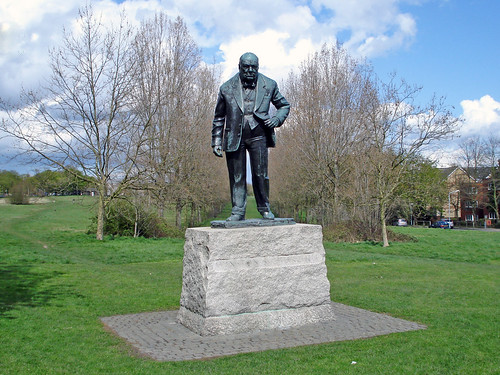
A ten-minute walk from where I live in East London, there are two monuments. One is large and impressive, and a well-known local landmark. The other is small and hidden, known only to a few locals, historians and researchers.
The large monument is a statue of the former local MP, Winston Churchill. He was the head of a wartime coalition government which turned the course of the second world war. He is rightly celebrated, and once stated "It has been said that democracy is the worst form of government except all the others that have been tried."
A short distance down the hill is a small triangular wooded patch of land opposite the tube station. This morning, a few straggly bluebells are blooming there in the watery sun. A small brass plaque shows that the copse was named Pankhurst Green in 1990, in honour of the sufragette Sylvia Pankhurst, who lived in a house nearby from 1932 to 1956. In fighting for the deocratic rights of women, she was imprisoned and force-fed many times before eventually achieving her objective in 1928, when all women, regardless of income or status, were finally allowed to vote.
Winston and Sylvia clashed many times in the village local village halls and the columns of the local paper. Winston was elected as both a Liberal and a Conservative MP, whereas Sylvia was at various times, a member of the Labour, Conservative and Communist parties. They disagreed on many things. However, there was one issue on which they were in full agreement; the importance of every citizen having a vote.
I know that many people are disillusioned with politics and politicians. 'Twas ever thus. Democracy is not a perfect system, and the likelihood is that this is the last general election without any element of proportional representation. However, voting is a right that we should cherish. I will be voting, as always, on election day. I remember Sylvia Pankhurst, who fought to give everyone that right, and Winston Churchill, who fought to let us keep it.
Please take just a few minutes on May 6th to use your vote.
The large monument is a statue of the former local MP, Winston Churchill. He was the head of a wartime coalition government which turned the course of the second world war. He is rightly celebrated, and once stated "It has been said that democracy is the worst form of government except all the others that have been tried."
A short distance down the hill is a small triangular wooded patch of land opposite the tube station. This morning, a few straggly bluebells are blooming there in the watery sun. A small brass plaque shows that the copse was named Pankhurst Green in 1990, in honour of the sufragette Sylvia Pankhurst, who lived in a house nearby from 1932 to 1956. In fighting for the deocratic rights of women, she was imprisoned and force-fed many times before eventually achieving her objective in 1928, when all women, regardless of income or status, were finally allowed to vote.
Winston and Sylvia clashed many times in the village local village halls and the columns of the local paper. Winston was elected as both a Liberal and a Conservative MP, whereas Sylvia was at various times, a member of the Labour, Conservative and Communist parties. They disagreed on many things. However, there was one issue on which they were in full agreement; the importance of every citizen having a vote.
I know that many people are disillusioned with politics and politicians. 'Twas ever thus. Democracy is not a perfect system, and the likelihood is that this is the last general election without any element of proportional representation. However, voting is a right that we should cherish. I will be voting, as always, on election day. I remember Sylvia Pankhurst, who fought to give everyone that right, and Winston Churchill, who fought to let us keep it.
Please take just a few minutes on May 6th to use your vote.
Wednesday, April 28, 2010
Gordon Brown and the MediaCoach Law of Microphones
The MediaCoach Law of MIcrophones states "Any microphone, at any time, is live, and will pick up an unguarded remark".
Alas, Gordon Brown forgot The Law today in Rochdale. After a five-minute discussion with a local resident, Gillian Duffy, he turned to get into his car, saying "It was nice to meet you".
However, once he thought he was out of earshot of all but his closest aides, he was recorded as saying "That was a disaster. You should never have put me with that woman. Whose idea was that?"
An aide responded "What did she say?"
Mr Brown replied: "Oh, everything, she's just a sort of bigoted woman who said she used to vote Labour."
The conversation was recorded and reported by Sky News. It's probably the biggest gaffe of the campaign so far. The Prime Minister has since apologised, when interviewed by Jeremy Vine on BBC Radio 2, after listening to a recording of his remarks.
The Tories have siezed on the issue to make political capital. Nick Clegg, the LibDem leader has declined to comment - wisely in my view.
The incident is an embarrassment. However, it's hardly surprising, given the stress of the campaign. I know that in their suppsed "private" moments, members of all parties express frustration with people. I've heard many of them say things (as we all do at times) that we wouldn't want recorded and broadcast. Unfortunately for Labour, it adds to the perception of an out-of-touch Government past its sell-by date.
John Major had a moment in a TV studio when he referred to three cabinet colleagues as "b**tards". During his 2000 presidential campaign, George W. Bush called New York Times reporter Adam Clymer a "major league a**hole" just before a speech, but not far enough away from a mike.
So remember, the mike is always on. The camera is always rolling, and there's always someone in earshot
Alas, Gordon Brown forgot The Law today in Rochdale. After a five-minute discussion with a local resident, Gillian Duffy, he turned to get into his car, saying "It was nice to meet you".
However, once he thought he was out of earshot of all but his closest aides, he was recorded as saying "That was a disaster. You should never have put me with that woman. Whose idea was that?"
An aide responded "What did she say?"
Mr Brown replied: "Oh, everything, she's just a sort of bigoted woman who said she used to vote Labour."
The conversation was recorded and reported by Sky News. It's probably the biggest gaffe of the campaign so far. The Prime Minister has since apologised, when interviewed by Jeremy Vine on BBC Radio 2, after listening to a recording of his remarks.
The Tories have siezed on the issue to make political capital. Nick Clegg, the LibDem leader has declined to comment - wisely in my view.
The incident is an embarrassment. However, it's hardly surprising, given the stress of the campaign. I know that in their suppsed "private" moments, members of all parties express frustration with people. I've heard many of them say things (as we all do at times) that we wouldn't want recorded and broadcast. Unfortunately for Labour, it adds to the perception of an out-of-touch Government past its sell-by date.
John Major had a moment in a TV studio when he referred to three cabinet colleagues as "b**tards". During his 2000 presidential campaign, George W. Bush called New York Times reporter Adam Clymer a "major league a**hole" just before a speech, but not far enough away from a mike.
So remember, the mike is always on. The camera is always rolling, and there's always someone in earshot
Monday, April 26, 2010
Advice to Gordon, David and Nick - How to perform well in a debate.
Debates are obviously in the news because of the UK election, and the novelty of having three party leaders live on stage. It may be the impact of the X Factor generation, but nevertheless, I believe that it has some merit. In the US elections, the head-to-head debates produced some fascinating tussles between Barack Obama and John McCain (and some dreadfully dull moments too). If you find yourself in a debate, here are some tips that may help you to come out on top.
* When you are speaking, you are in control. Make sure that you finish your point strongly.
* Keep your points brief, with rehearsed phrases emphasised
* Know in advance of the debate what impression you wish to create
* Never lose your temper. If your opponents do, stay even calmer
* Ask for the right to reply to false accusations
* Allow yourself to be interrupted only on your strongest points
* Short, concise points can be deadly. Use them well
* Stand tall, and look at the audience
* Have a short, strong, well-prepared closing statement
It's all about calmness, confidence and getting a clear message across. That's what wins debates.
* When you are speaking, you are in control. Make sure that you finish your point strongly.
* Keep your points brief, with rehearsed phrases emphasised
* Know in advance of the debate what impression you wish to create
* Never lose your temper. If your opponents do, stay even calmer
* Ask for the right to reply to false accusations
* Allow yourself to be interrupted only on your strongest points
* Short, concise points can be deadly. Use them well
* Stand tall, and look at the audience
* Have a short, strong, well-prepared closing statement
It's all about calmness, confidence and getting a clear message across. That's what wins debates.
Subscribe to:
Posts (Atom)