Well, well, the BBC has got itself into a proper tangle over whether to play "Ding dong, the witch is dead", now standing at number three in the charts after a campaign to demonstrate feelings about the recently deceased Baroness Thatcher. An uneasy compromise has been announced by the Beeb, with a "clip" of the song being played as part of a "news item". Since the song is only fifty-one seconds long anyway, a clip may well go un-noticed.
It's easy to understand the offence that could be caused by playing the song, before a funeral has even taken place. It's hardly a precedent, since in years past, BBC has banned a number of tracks, including "Give Ireland back to the Irish" by Wings, "God Save the Queen" by the Sex Pistols, and even "Boom bang-a-bang" by diminutive popster Lulu, which was removed from airplay during the first Gulf War.
Of course, times change, and almost all of the songs once banned by the BBC are now played on a regular basis. However, censorship has always been arbitrary. For example, it's hard to understand how songs like "Walk on the Wild Side" by Lou Reed escaped the censors, other than they presumably had no idea what "giving head" meant.
Is the BBC's muddled solution the correct one? Since it will probably attract complaints from both sides, it may be seen as maintaining impartiality. In a few months time, the whole thing will have been forgotten, and people will be wondering what was all the fuss about a song from the 1930s that lasts less than a minute, and has no rude words in it.
I suspect that Baroness Thatcher herself would have been highly amused by the affair. She never shirked controversy, and even seemed to thrive on it. Any wicked witch would have stood no chance against her.

Friday, April 12, 2013


Thursday, April 11, 2013
The Media Coach 12th April 2013
Hints and tips for media appearances, speaking and social media. This week; Legacy (it’s a theme); Margaret Thatcher; The Olympics; David Mellor; A sorry bunch of Cher fans; Leave a lasting impression; That’s not what you said before; Your social media footprints don’t fade; An interview with Darren Lacroy; Music from Simon Kirke
Monday, April 08, 2013
Margaret Thatcher has died. What is her legacy?
The former grocer's daughter from Grantham will undoubtedly be listed alongside the likes of Winston Churchill and Tony Blair as someone who affected a nation. While Churchill's legacy is strongly positive, Mrs Thatcher's is far more mixed. She gave rise to a noun - "Thatcherism" as a result of her economic strategy, the effects of which are still felt to this day.
To many, she is seen as the saviour of modern Britain. To others, she was someone so focused on her ideology that the damage done by her policies ran deep.
Politics apart, from my point of view as a media commentator, she was one of the best interviewees ever. She always got her point across, regardless of the impertinent questions of her interlocutors. With her PR guru, Lord Bell, she planned many an ambush on policies she disagreed with, such as laying her handkerchief across the tails of model planes painted in the new British Airways livery.
Her funeral will be a huge public event - probably the largest political funeral since Winston Churchill's in the sixties. I shall bid her a fond farewell, not because I agreed with every one of her policies, but as an admirer of her fortitude, courage and powerful communication style.
We shall not see her like again for many a long year.
Picture Credit: By work provided by Chris Collins of the Margaret Thatcher Foundation (Margaret Thatcher Foundation) [GFDL (http://www.gnu.org/copyleft/fdl.html) or CC-BY-SA-3.0 (http://creativecommons.org/licenses/by-sa/3.0/)], via Wikimedia Commons
Twitter doesn't love Paris in the springtime.
A Twitter storm has been raging over the appointment of 17-year-old Paris Brown as as Britain’s first Youth Police and Crime Commissioner. She's only a few days into her £15,000 a year post, yet, her competence has been questioned by national newspapers and thousands of Twitter users.
The problem has been caused by tweets that she sent between the ages of 14 and 16, which have been described as offensive, homphobic and drug-related. There's little doubt that the language she used was strong, and the comments very direct, but should she's still very young, and has offered a full apology.
I suspect that if the social media feeds of most young teenagers were analysed, it would be easy to find something to complain about. The question is, should the sorts of daft things that teenagers say be held against them in future? In another more adult sphere, John O'Farrell, the Labour candidate in the recent Eastleigh by-election, was pilloried for a statement he made about Margaret Thatcher many years ago.
In matters of reputation, public judgement always comes into play. What matters is whether people have enough support to ride out the storm, or whether their past behaviour will forever make them "damaged goods". A quick and heartfelt apology always helps, but at the end of the day, it's the opinion of the people they serve that matters. Will they be able to do their job in future, and will people have confidence in them? It looks to me as though the pressure to remove Miss Brown has reached such a peak that it will be hard for her to remain in post, despite the support of her sponsor.
The problem has been caused by tweets that she sent between the ages of 14 and 16, which have been described as offensive, homphobic and drug-related. There's little doubt that the language she used was strong, and the comments very direct, but should she's still very young, and has offered a full apology.
I suspect that if the social media feeds of most young teenagers were analysed, it would be easy to find something to complain about. The question is, should the sorts of daft things that teenagers say be held against them in future? In another more adult sphere, John O'Farrell, the Labour candidate in the recent Eastleigh by-election, was pilloried for a statement he made about Margaret Thatcher many years ago.
In matters of reputation, public judgement always comes into play. What matters is whether people have enough support to ride out the storm, or whether their past behaviour will forever make them "damaged goods". A quick and heartfelt apology always helps, but at the end of the day, it's the opinion of the people they serve that matters. Will they be able to do their job in future, and will people have confidence in them? It looks to me as though the pressure to remove Miss Brown has reached such a peak that it will be hard for her to remain in post, despite the support of her sponsor.
Saturday, April 06, 2013
Delivering a speech? Finish big.

The closing line of your speech may be the one thing that members of your audience remember as they leave the hall. It's critically important that you deliver it well, and that the content is spot-on. Ideally, it should mirror your opening line, and provide exactly what you promised at the start of your speech.
What are the essential elements of a good close?. I think they include some or most of these:
- Indicate that you are about to finish ("and in conclusion")
- Re-state your core message
- Refer back to the start of your speech
- Use the word "you"
- Call your audience to action
- Deliver a ringing phrase
- Use an analogy ("just as Churchill said")
- Use a quote
- Say simply "Thank you"
- Stay on stage and take the applause
Here's how Winston Churchill did it on June 18th 1940: "But if we fail, then the whole world, including the United States, including all that we have known and cared for, will sink into the abyss of a new Dark Age made more sinister, and perhaps more protracted, by the lights of perverted science. Let us therefore brace ourselves to our duties, and so bear ourselves that if the British Empire and its Commonwealth last for a thousand years, men will still say, 'This was their finest hour.'"
Picture Credit: Alan Stevens
Thursday, April 04, 2013
The Media Coach 5th April 2013
Hints and tips for media appearances, speaking and social media. This week: Fascists and football; Bonkers Barking; The Mobile Phone at 40; George, innit?; Finish Big; How Local News Works; Do I need video?; An interview with Derek Arden; Music from the Lost Hollow Band
Wednesday, April 03, 2013
It's economics, innit? George Osborne goes Mockney.
George Osborne, the Chancellor of the Exchequer, was at in Kent yesterday making a speech about welfare reform. He was speaking to workers from Morrison's supermarket at one of their regional distribution centres. A standard political set-piece event, staged mainly for the six o'clock news. But something strange happened to his voice. Instead of his clipped and somewhat posh accent, he said "wanna', "Briddish" and dropped many a "T" from his words. It was quite bizarre, like hearing Prince Charles trying to rap.
What was he thinking? The answer is that he probably wasn't. Changing our speech pattern in different environments is something most of us do. It's known as communication accommodation, and is a well-documented phenomenon. It's particularly noticeable in people whose accents have changed after living a long way from their birthplace, who suddenly revert to their original tones when speaking to friends and family who stayed put.
For most people, it's not a problem, since it's often not noticed, or seen as being "just one of those things". For a politician, however, it's much more of an issue. If Mr Osborne is regarded as deliberately changing his accent to appeal to a certain group, it can be seen as false (an attribute many people associate with politicians anyway). It would be sensible for him, and other politicians, to make a conscious effort to keep the same accent at all times. I'm sure his advisors will have pointed this out to the Chancellor, and I suspect we won't hear him doing it again. Funny old world, innit?
What was he thinking? The answer is that he probably wasn't. Changing our speech pattern in different environments is something most of us do. It's known as communication accommodation, and is a well-documented phenomenon. It's particularly noticeable in people whose accents have changed after living a long way from their birthplace, who suddenly revert to their original tones when speaking to friends and family who stayed put.
For most people, it's not a problem, since it's often not noticed, or seen as being "just one of those things". For a politician, however, it's much more of an issue. If Mr Osborne is regarded as deliberately changing his accent to appeal to a certain group, it can be seen as false (an attribute many people associate with politicians anyway). It would be sensible for him, and other politicians, to make a conscious effort to keep the same accent at all times. I'm sure his advisors will have pointed this out to the Chancellor, and I suspect we won't hear him doing it again. Funny old world, innit?
Tuesday, April 02, 2013
Once a fascist, always a fascist? The Di Canio conundrum
There's no doubt that Paolo Di Canio is (or was) an incredibly gifted footballer, capable of acts of breathtaking skill on the pitch. There's also no doubt that he's also committed some bizarre acts both on and off the pitch that also take one's breath away. He's what's known as a "character", which is often another way of saying "I'm glad he's not in our team".
The problem for many people with his appointment is his declaration of fascist sympathies. He wrote in his autobiography about his views on the former Italian fascist leader, Benito Mussolini; "I think he was a deeply misunderstood individual. He deceived people. His actions were often vile. But all this was motivated by a higher purpose. He was basically a very principled individual.” Mr Di Canio has also said that his own views are "fascist, not racist", which probably comes as little comfort to those trying to defend his reputation, which was also damaged by his delivery of a straight-arm fascist salute in Rome in 2005 after he scored for Lazio against bitter local rivals Roma.
Since then, he's managed Swindon Town, with barely a raised eyebrow in the media, though the local GMB union withdrew their financial support for the club. So why is there such a media furore now over his views? It's partly timing, since Easter is a quiet time for news. It's partly, with all due respect to Swindon Town, that Sunderland is a higher profile club. It's partly that David Milliband has resigned from the club's board in protest (though presumably his departure for New York would have meant his departure was imminent anyway). But mostly, I think, it's because Paolo Di Canio himself attracts (one might even say courts) publicity.
The issue for most Mackems, I suspect, is not his political views, but whether he can keep the club in the premiership. There are some, a few of whom were on the radio today, who believe that his appointment is wrong, regardless of the outcome. In a day or two, I suspect the storm over his political past will blow away, and matters on the pitch will take precedence. But for now, I would urge Mr Di Canio to keep his hands firmly in his pockets.
Picture Credit: Wikipedia, Creative Commons Licence
Monday, April 01, 2013
Saturday, March 30, 2013
10 questions for event organisers to ask virtual presenters
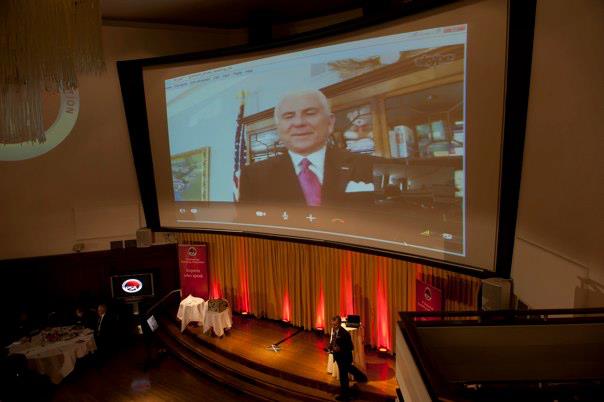 |
Here’s a check-list of questions that will help you to choose a virtual presenter that will delight your audience.
1) How much virtual presenting have you done? Everyone has to start somewhere, but if you have an large, important event to organise, it’s unwise to risk a first-time or inexperienced virtual presenter. Allow them to gather experience at smaller events.
2) What software have you used? Every technology requires some knowledge and experience to make best use of it. Whether you are using Skype, GoToMeeting or any other system, ensure that presenters know how to use it.
3) What technology do you have? A reliable connection is a must. So is high-quality sound. Good virtual presenters will have a hard-wired, high-speed internet connection and a good external microphone.
4) Can we see testimonials? The view of other organisers is always a strong indication of how good a virtual presenter really is.
5) What training have you done? There are some skills required for virtual presentations, and any presenter who has had no training at all is going to be a risk.
6) Can we have a chat on Skype? You can use a Skype conversation to make a live assessment of someone’s skills. Ask them a question that requires a detailed answer, sit back, watch and listen. How good would they look and sound in front of your audience?
7) Can we see your YouTube channel? You can make a good assessment of someone’s on-screen skills by looking at how they communicate on video. They don’t upload videos? Look for someone else.
8) What do you think are the key skills of a virtual presenter? They should be able to tell you the important skills required - confidence, looking into the camera at all times, limited use of notes and the ability to “project” into the room.
9) Are you prepared to engage with the audience before and after your presentation? How would you do that? You need a “yes” to the first part, and a sensible response to the second.
10) Are you prepared to appear at short notice? Sometimes, the best plans need to change. If you need to bring in a speaker at short notice, is this someone you could rely on?
How do you assess the responses? There is no list of “right answers”, but any shuffling of the feet and embarrassed mumblings will reveal a great deal. In my opinion, demonstrable results and testimonials rank high on the selection criteria, but it depends exactly what your event is looking for, and is prepared to pay for.
I've delivered many virtual presentations, and I'm still discovering ways to offer an even better service. Don't risk the success of your event by booking a virtual presenter who can't deliver the goods.
Photo Credit - John Cassidy (Headshots)
Thursday, March 28, 2013
The Media Coach 29th March 2013
Hints and tips for media appearances, speaking and social media. This week; Easter Eggs; Abu Dhabi virtually; Renault surprise; Boris Johnson; Being there virtually; I wasn’t expecting that; The one (channel) show; An interview with Kate Russell; Music from The Lost Hollow Band.
Sunday, March 24, 2013
Boris on the back foot
When a leading politician is interviewed on a national politics show, they should expect some tough questions. In the majority of cases, they have anticipated the questions and prepared a response. That's simply good planning for a media interview. Perhaps Boris thought that his natural charm would see him through, but he was completely mistaken.
Here are some examples from the exchange:
Eddie Mair: "The Times let you go after you made up a quote. Why did you make up a quote?"
Boris Johnson; "Well..er...these are big terms for...er...what happened was...I can tell you the whole thing....er...are you sure our viewers wouldn't want to hear more about..er..."
He then gave a defence of his actions, but hardly a convincing one. Here's another:
Eddie Mair: "Let me ask you about a bare-faced lie. When you were in Michael Howard's team, you denied to him you were having an affair. It turned out you were, and he sacked you for that. Why did you lie to your party leader?"
Boris Johnson: "Well....I mean again...er...on that... never had any conversation with Michael Howard about that matter. I do not propose to go into all that again. Why should I? I've been through it a lot. Watch the documentary. Why don't we talk about something else?"
He was also quizzed about agreeing to supply the address of a journalist to Darius Guppy, an old friend, who said that he wanted to have the journalist "beaten up". Mr Johnson's reply included the comment "I think if any of us had our phone conversations bugged, people say all sorts of fantastical things whilst talking to their friends."
Eddie Mair then summed the dialogue up with the damning phrase "You're a nasty piece of work, aren't you?". The response from the Mayor of London was far from convincing; "All three things I would dispute … if we had a longer time I could explain that I think all three interpretations you are putting on these things are not wholly fair".
There were then a few totally expected questions about his alleged ambition to lead his party, which elicited the phrase "an increasingly hysterical conversation", but no real answer.
And that was it. Overall, it was a right grilling. Boris Johnson undoubtedly suffered reputational damage from the exchange. Should he have done it? Absolutely, in my opinion. Should he have been better prepared? Absolutely. Will he fail to prepare in future? Possibly.
The lesson for anyone faced with a tough interview is to prepare well. If you have to admit something, admit it early and say sorry. If you want to be a leader, you have to go into the lion's den properly armed.
Thursday, March 21, 2013
The Media Coach 22nd March 2013
Hints and tips for media appearances, speaking and social media. This week; iPads to the ready; video cards; TV proposal; Death Wish Coffee; Budget Leak; Just the facts please; Tips for TV debates; Is it the medium or the message?; An interview with Steve James of Doceri; Music from Mick Terry
Sunday, March 17, 2013
Speakers - Just the facts, please
What's the point of this? It's that if speakers tell audiences something, it's their responsibility to check that (at least to the best of their ability) that they're telling the truth. Here are a few widely-used misconceptions:
1) 'We only use 10% of our brains". Untrue. This is often mis-attributed to Albert Einstein, though there's no evidence he ever said it, let alone believed it. Neurologists have long known that we use most of our brains, most of the time.
2) "Lemmings commit mass suicide by jumping off cliffs". Untrue. The phenomenon has never been seen in nature. The idea comes from the Disney film White Wilderness, when cameramen pushed lemmings over a cliff.
3) "The Vauxhall Nova sold poorly in Spain because it means 'doesn't go' in Spanish". Untrue. Thousands of Spanish speakers worked on the project, and would obviously have noticed any problem. In fact it sold well in Spain, and many other Spanish-speaking countries.
4) "NASA spent millions developing a pen that would write in space, while the Russians used a pencil" Untrue. Both the US and Russian astronauts used pencils on early missions, then both used pens designed by the Fischer company at no cost to the space programs.
I've heard all these points, and many more, used by speakers to get a message across. If they have the desired impact, does it matter if they are false? I believe it does. If an element of a speech is untrue, what is the veracity of the remainder? In years past, I have used a couple of the statements above myself, until I took the time and trouble to check them out. Now I try to verify everything I say, unless it's my opinion, when I make that clear.
So let's please try to stick to just the facts.
Subscribe to:
Posts (Atom)